

Carved beneath the eastern coast of Mallorca over millions of years, the Cuevas del Drach (Dragon Caves) are among the most visited natural attractions in all of Spain. This system of four interconnected caves stretches over 4 kilometers in length and plunges 25 meters below the surface, revealing a subterranean world of dramatic stalactites, translucent pools, and one of the largest underground lakes on Earth.
History and Discovery
The caves were first documented in 1338, when a military expedition explored the entrance passages by torchlight. For centuries, locals referred to the caves in hushed tones, associating their dark labyrinthine corridors with dragon lore, which gave rise to the name "Dragon Caves."
It was not until 1896 that French speleologist Edouard-Alfred Martel undertook the first scientific exploration of the cave system. Martel mapped the extensive network and discovered the vast underground lake that would later bear his name. His expedition revealed a cave of extraordinary geological significance, with formations dating back several million years.
The caves were opened to the public in the early 20th century and have since become one of Mallorca's most iconic landmarks. Today, more than one million people visit the Cuevas del Drach annually, making them one of the most popular subterranean tourist sites in Europe.
The Four Caves
The system comprises four distinct but interconnected caves, each with its own character and geological features:
Black Cave (Cueva Negra)
The first cave encountered on the standard tour, characterized by dark limestone walls and narrow passageways. Minimal artificial lighting preserves the sense of natural mystery that early explorers would have experienced.
White Cave (Cueva Blanca)
Named for the pale calcite deposits that coat its walls, this section features some of the most delicate stalactite formations in the entire system. The calcium carbonate has been shaped by water over approximately 5 to 6 million years.
Cave of Luis Salvador (Cueva de Luis Salvador)
Named after Archduke Ludwig Salvator of Austria, who sponsored early explorations. This section features towering columns where stalactites and stalagmites have merged over millennia, some reaching heights of over 10 meters.
Cave of the French (Cueva de los Franceses)
The deepest section of the system, this cave leads to Lake Martel. The passage narrows dramatically before opening into the vast chamber that houses the lake, creating a powerful sense of discovery.
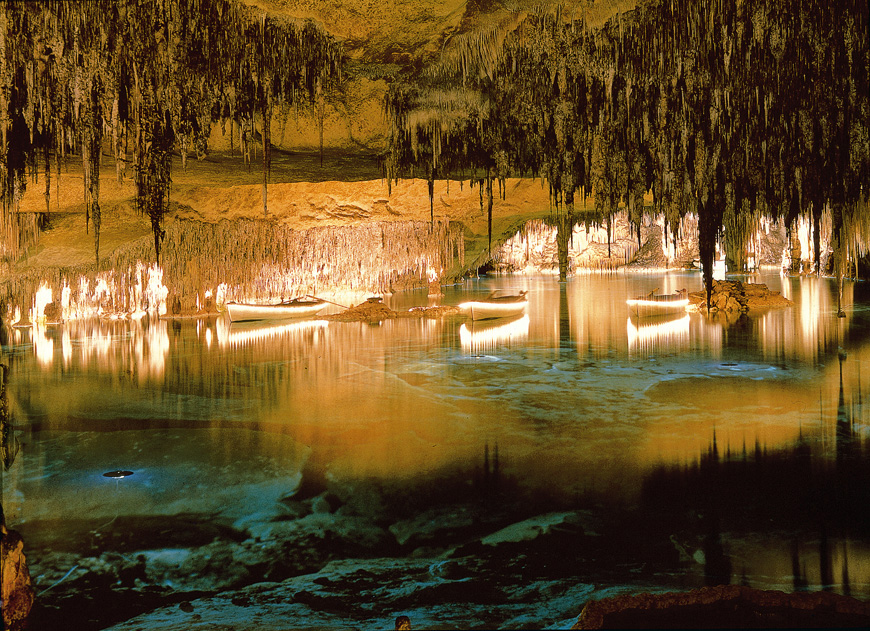 Lake Martel inside the Cuevas del Drach, illuminated for visitors. Photo: Wikimedia Commons / Public Domain
Lake Martel: The Underground Concert Hall
The crown jewel of the Cuevas del Drach is Lake Martel (Lago Martel), an underground lake measuring approximately 115 meters in length and 30 meters in width. Named after the French explorer who discovered it, the lake is one of the largest subterranean bodies of water in the world.
What makes the lake particularly special is the daily classical music performance. Musicians in small, illuminated boats glide across the dark water, performing short pieces by composers such as Bach and Chopin. The acoustics of the cave chamber amplify the music in a way that makes the experience unforgettable.
After the concert, visitors can take a short boat ride across the lake before exiting through a separate passage. The entire visit takes approximately one hour, with the concert lasting about 10 minutes.
Visitor Information
Location
Ctra. Cuevas, s/n, 07680 Porto Cristo, Mallorca, Spain. Located approximately 65 km east of Palma de Mallorca, the caves are accessible by car (about 1 hour) or by public bus from Palma or Manacor.
Opening Hours
Open daily. Tours depart approximately every hour from 10:00 to 17:00 during summer (April to October), and from 10:45 to 15:30 during winter (November to March). It is advisable to check the official website for the most current schedule.
Ticket Prices
Adult tickets are approximately 16 EUR. Children aged 3 to 12 pay around 10 EUR. Tickets purchased online may offer a slight discount. Group rates are available for parties of 20 or more.
Accessibility
The caves include paved walkways and handrails, though some sections involve steep stairs. Visitors with mobility difficulties should inquire about accessible routes. The temperature inside is a constant 21 degrees Celsius with high humidity.
Getting the Most from Your Visit
For the best experience, try to arrive at least 15 minutes before your scheduled tour time. Photography without flash is permitted throughout the caves. The gift shop at the entrance sells guidebooks and souvenirs, and there is a small cafe for refreshments after the tour.
If you are visiting Mallorca in July or August, book tickets at least several days in advance, as tours frequently sell out. Early morning and late afternoon slots tend to be less crowded. Combining a cave visit with an afternoon in the nearby town of Porto Cristo makes for a satisfying day trip.